EPDM vs. TPO for Colorado Warehouses: What the Front Range Does to Your Roof
At 5,280 feet, spec sheets mean less. What matters is how the membrane performs after its tenth hailstorm, its thousandth freeze-thaw cycle, and 300 days of altitude UV.
Why Denver Is One of the Hardest Markets on a Commercial Roof
Colorado warehouse owners hear about EPDM and TPO as if they're interchangeable. They're not — and nowhere is that more true than the Front Range.
Colorado experiences about 94 hail events each year, leading to approximately $151 million in annual property losses.(A Statistical Breakdown of Hail Damage in Colorado)
The May 2017 supercell caused $2.3 billion in insured losses across the Denver metro, and the May 2024 storm produced hail up to 2.75 inches with roughly $1.9 billion in damage. (Hail, Wind, and Storm Damage to Denver, CO Roofs: What Every Homeowner Must Know)
Add UV radiation 20 to 25 percent stronger than at sea level, daily temperature swings of 50 degrees, heavy spring snow loads, and Denver's Green Buildings Ordinance requiring cool roofs on commercial buildings over 25,000 square feet — and the membrane decision has more financial consequence here than almost anywhere else in the country.
At S-Bar Construction, we've installed and repaired both systems on industrial buildings along the Front Range. This isn't a manufacturer's comparison. It's what we've learned on the roof.
The Basics: What You're Choosing Between
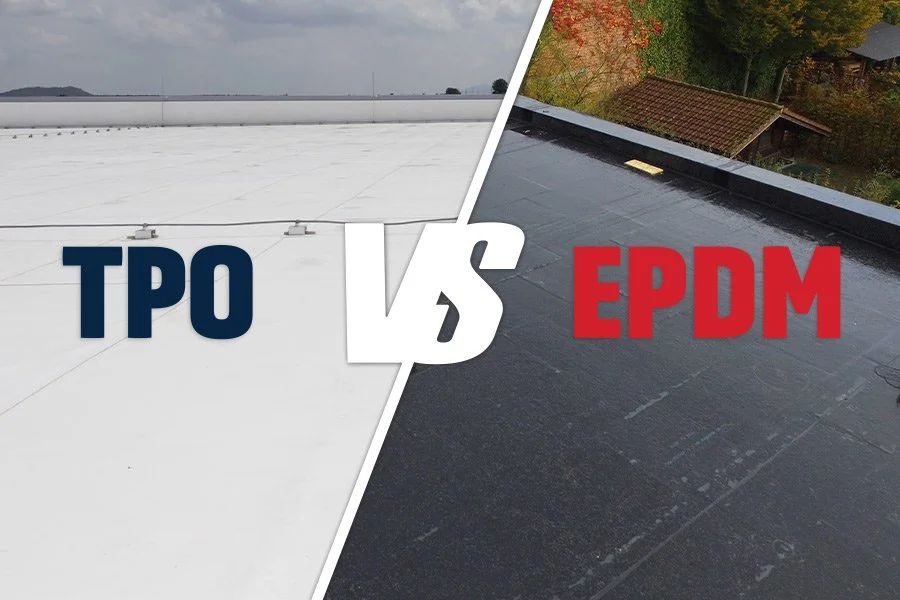
EPDM (Ethylene Propylene Diene Monomer) is a synthetic rubber membrane with over 50 years on the market. It's typically black, naturally flexible, and bonds to itself using adhesive tape or liquid primers. EPDM stretches up to 300 percent, which means it moves with your building as temperatures swing without cracking or tearing. It's the legacy system on commercial roofs for a reason — it works, and it lasts.
TPO (Thermoplastic Polyolefin) is a newer thermoplastic membrane, typically white, that's gained significant market share over the last two decades. TPO seams are heat-welded using robotic hot-air welders, fusing two sheets into a single continuous surface — stronger and more leak-resistant than adhesive seams. Its reflective surface bounces UV energy off the roof, reducing cooling loads. TPO now commands roughly 40 to 50 percent of the national single-ply market, and Denver follows this trend on new construction.
Both are single-ply systems installed in large rolls on flat or low-slope roofs. Both can be mechanically attached, fully adhered, or ballasted. The difference isn't in the category — it's in the chemistry, and how that chemistry responds to what the Front Range does to a building year after year.
How the Front Range Tests Each System
Hail: The defining risk.
EPDM is a thermoset rubber — it absorbs impact the way a rubber mat does. When a two-inch hailstone hits at 60 to 80 mph, the rubber flexes, absorbs the energy, and recovers. TPO handles hail well when new, but as the membrane ages and plasticizers migrate, it becomes more brittle. Older TPO hit by large hail develops "star-cracking" — radial fractures around the impact point that create leak paths. On a 100,000-square-foot warehouse, a single severe hailstorm on aging TPO can turn a maintenance issue into a capital event. For hail resilience, EPDM has a clear advantage.
UV intensity at altitude.
Both systems handle altitude UV, but through opposite mechanisms. EPDM's carbon black composition is inherently UV-stable — it doesn't degrade under sustained exposure. TPO reflects UV away with its white surface, keeping the membrane cooler. Early TPO formulations struggled at altitude with premature chalking, though modern products have largely resolved this. In Colorado, manufacturer selection matters — we only spec TPO from manufacturers with documented high-altitude performance data.
Freeze-thaw cycling.
EPDM stretches up to 300 percent, making it exceptionally forgiving when Denver swings 50 degrees in a day. The rubber moves with the building's thermal expansion and contraction without losing integrity. TPO's polyester scrim reinforcement limits its flexibility compared to rubber — it performs in freeze-thaw conditions, but the membrane and seams work harder over 15 to 20 years of daily cycling.
Snow load and ponding.
Colorado's spring storms can drop 12 to 18 inches of heavy, wet snow in a single event. As it melts, ponding water tests drainage and seam integrity. EPDM's adhesive seams can soften under prolonged ponding. TPO's heat-welded seams are more resistant. On warehouses with flat drainage profiles and known ponding areas, TPO has a seam advantage worth considering.
The Denver Recommendation
For existing industrial buildings where hail resilience and long-term durability are the priority: EPDM — specifically 90-mil reinforced EPDM. The hail performance, thermal flexibility, and proven Colorado longevity make it the strongest choice for owners who want a 25-to-35-year roof. If the work qualifies as repair rather than full replacement, you avoid the GBO cool roof trigger entirely.
For new construction and full replacements on climate-controlled warehouses: TPO at 60-mil or 80-mil thickness. It meets the GBO natively, reduces cooling costs during Denver's increasingly warm summers, and provides superior seam performance against spring ponding. Do not spec anything thinner than 60 mil in Colorado. The hail risk does not justify the savings.
For buildings that need both: We've executed hybrid specs — TPO on the primary field area for reflectivity and compliance, with reinforced EPDM at high-traffic zones and around rooftop equipment where impact resistance matters most. Not standard, but for the right building, it delivers the best of both systems.
Straight Answers
Is EPDM still a good choice given Denver's cool roof push?Yes — for the right application. EPDM remains one of the best-performing membranes in Colorado for hail and thermal flexibility. The cool roof mandate applies only to full replacements on buildings over 25,000 square feet. If your EPDM is sound and only needs repair, maintaining it is usually the best financial decision. When full replacement comes, white EPDM or a reflective coating can comply — or TPO becomes the cleaner path.
Should I spec thin TPO to save on installation cost?No. A 45-mil TPO cracks faster under hail, degrades faster under altitude UV, and fails earlier in freeze-thaw cycling than a 60-mil or 80-mil system. On an industrial roof in Denver, membrane thickness has more long-term financial impact than almost any other line item. We won't spec below 60 mil on a Colorado industrial project.
How does insurance factor into the decision?Colorado wind and hail deductibles are increasingly percentage-based, typically 1 to 5 percent of coverage, and some carriers are restricting new business in highest-risk zones. (Colorado Property Insurance Update: Wildfires, Hail & Premium Relief)
An impact-resistant system can help negotiate better terms. EPDM's inherent hail resistance is recognized by some underwriters. Document your membrane specification and thickness when discussing coverage.
What's the realistic lifespan of each system in Denver? A well-installed 90-mil EPDM, properly maintained, delivers 25 to 35 years on the Front Range. We've seen Colorado EPDM installations from the 1980s still performing. TPO at 60 mil or thicker from a quality manufacturer delivers 20 to 25 years. Thinner or lower-quality TPO will fall short — Denver's altitude UV and hail are unforgiving to minimum-spec systems.
The S-Bar Approach
We don't default to one membrane system. We default to the right system for the building, the climate, and the owner's capital plan. That means we assess every facility individually — roof condition, structural capacity, tenant requirements, local code obligations, and the owner's timeline for the asset — before we recommend EPDM, TPO, or in some cases, a different system entirely.
For portfolio owners with buildings across multiple climate zones, this matters even more. The right answer in Colorado is not the right answer in Texas. A program contractor who installs both systems and understands why each performs where it does can standardize your quality without standardizing your spec — which is how you get the best lifespan and the best ROI out of every roof in the portfolio.
Contact S-Bar Construction to schedule a roof assessment. www.sbarconstruction.com