
EPDM vs. TPO in Texas — What Your Warehouse Roof Is Up Against
Why Texas Is One of the Hardest Markets on a Commercial Roof
Texas warehouse owners think about heat first. Fair enough — a black roof in Houston can exceed 170°F in July. But heat is only one variable in a climate that tests every component simultaneously: extreme UV combined with sustained humidity, hurricane-season wind uplift, chemical exposure from refineries and industrial corridors, and flat drainage profiles that make ponding water a year-round problem.
At S-Bar Construction, Texas is our home market. Here's how EPDM and TPO actually perform in conditions Texas throws at them.
How Texas Climate Hits Each System
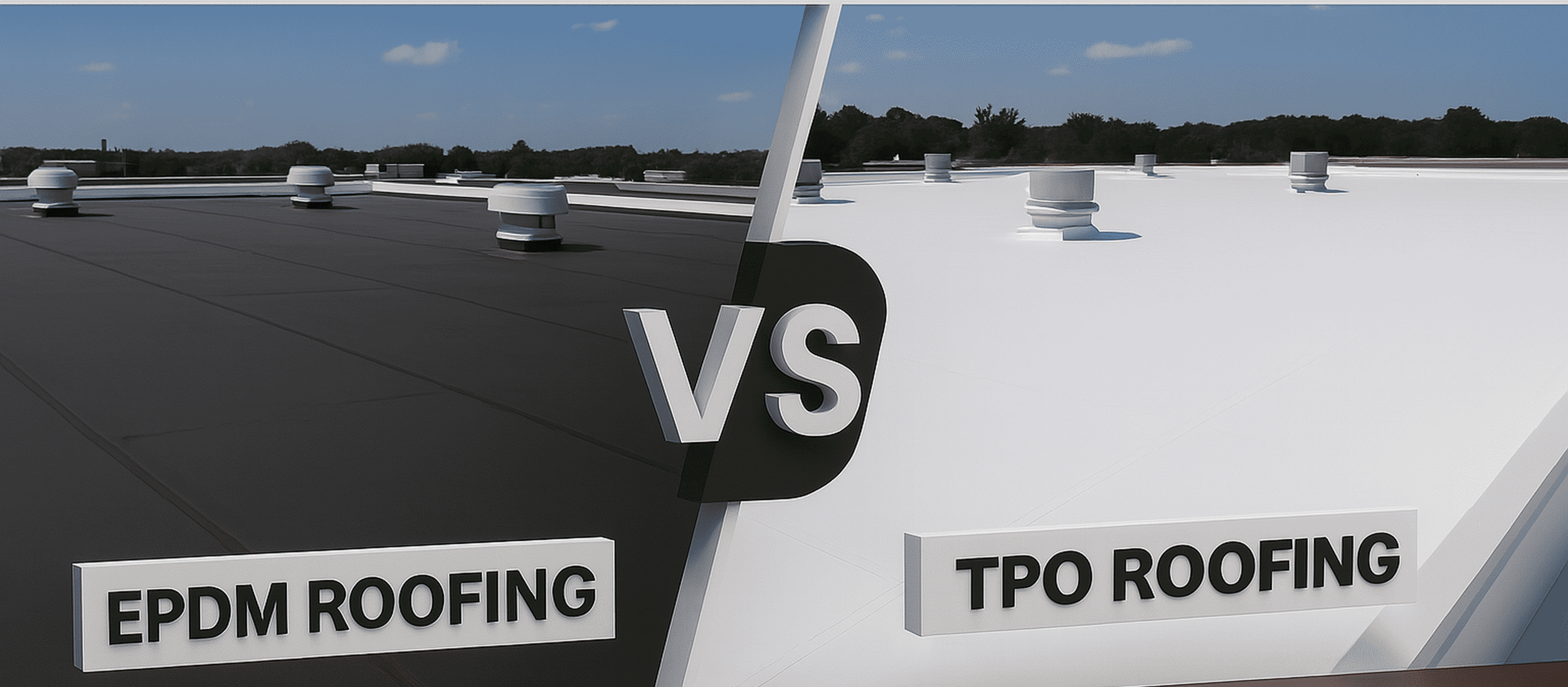
Heat and UV. Texas averages 230–250 sunny days per year. A black EPDM surface stays above 150°F for months at a time, driving up cooling costs significantly. TPO's white reflective surface stays within 10–15 degrees of ambient air temperature. In a 100,000-sq-ft warehouse, the annual cooling cost difference can run into tens of thousands of dollars. In a market where AC runs eight to nine months a year, this isn't marginal — it's a primary financial driver.
Humidity and seam integrity. Houston sustains relative humidity above 75% for much of the year. EPDM seams are adhesive-bonded — in high-moisture environments, those bonds degrade faster, creating water entry points. TPO seams are heat-welded into a single monolithic surface with no adhesive involved. In the Gulf Coast market, that's a meaningful long-term advantage and a real reduction in maintenance exposure.
Wind uplift and hurricanes. Both systems can be engineered to meet high wind uplift requirements when properly attached. Where TPO pulls ahead: its welded seams are more resistant to wind-driven rain. When a hurricane pushes water laterally at high velocity, it finds every seam weakness. Adhesive seams that have aged are more vulnerable than fused welded seams.
Chemical exposure.
This is where the Gulf Coast gets specific. EPDM is a rubber compound — it swells and degrades when exposed to petroleum byproducts, animal fats, and certain solvents. If your warehouse is near a refinery, processing plant, or food-grade freight operation, EPDM's lifespan will fall short of what the spec sheet suggests. TPO has substantially better chemical resistance. For facilities in or near Gulf Coast industrial corridors — the Houston Ship Channel, Beaumont-Port Arthur, and the Freeport-Brazosport petrochemical complex — TPO is the safer long-term choice.
Ponding water. Large industrial roofs in Texas are often built flat with aging drainage design. TPO's welded seams handle ponding better than EPDM's taped seams, but the real solution is proper drainage design at installation. S-Bar evaluates drainage as a primary design consideration — not an afterthought.
The Texas Recommendation
For most Texas industrial warehouses, TPO is the stronger choice. We recommend 60-mil TPO minimum for industrial applications; 80-mil for DFW-area buildings with elevated hail exposure, heavy rooftop equipment, or high foot traffic.
EPDM still earns its place on non-climate-controlled facilities where cooling cost isn't a factor, or in remote West Texas locations where access to certified heat-welding labor is limited. EPDM can be patched by a general maintenance crew; TPO repairs require a trained welder.
What Texas Owners Get Wrong Most Often
Choosing on installed price alone. A 45-mil TPO system costs less upfront and degrades faster under Texas UV, with less hail resistance and a shorter warranty. We've seen owners save $0.50/sq ft on installation and spend three times that on early replacement.
Ignoring drainage during a re-roof. If your existing roof has ponding issues and you install a new membrane over the same drainage profile, you're putting a new system on top of an old problem. We add tapered insulation, cricket systems, or supplemental drains where the existing design falls short.
Assuming all TPO is the same. TPO formulations vary by manufacturer. Early-generation products had documented UV degradation issues in high-heat environments. Modern formulations have largely resolved this — but manufacturer selection still matters. We spec TPO with proven performance data in Gulf Coast and Sun Belt conditions.
Quick Answers
Does white TPO lose reflectivity as it gets dirty?
It accumulates dirt over time, but the cooling benefit doesn't disappear. Even a moderately soiled white membrane still reflects far more solar energy than black EPDM. Periodic cleaning restores most of the performance.
Can I install TPO over existing EPDM without a full tear-off?
Sometimes yes. Texas codes generally allow one recovery, provided the existing membrane is dry and insulation is sound. S-Bar performs a core cut and moisture survey first — if we find wet insulation, a full tear-off is the only responsible path.
Realistic lifespan in Houston?
A properly installed 60-mil TPO from a reputable manufacturer: 20–25 years. EPDM in the same market: 20–30 years, but with higher interim maintenance costs on seams. Annual inspections matter more than membrane type for long-term performance.
The S-Bar Approach
We've installed and maintained both systems through Texas summers and Texas storms. When we recommend TPO — and we usually do — it's because we've seen what Gulf Coast humidity does to adhesive seams, what 170°F surface temperatures do to cooling budgets, and what chemical exposure does to rubber membranes near the Ship Channel.
Contact S-Bar Construction to schedule a roof assessment. www.sbarconstruction.com