Gravel vs. Asphalt vs. Concrete: Choosing the Right Surface for Your Texas IOS Site
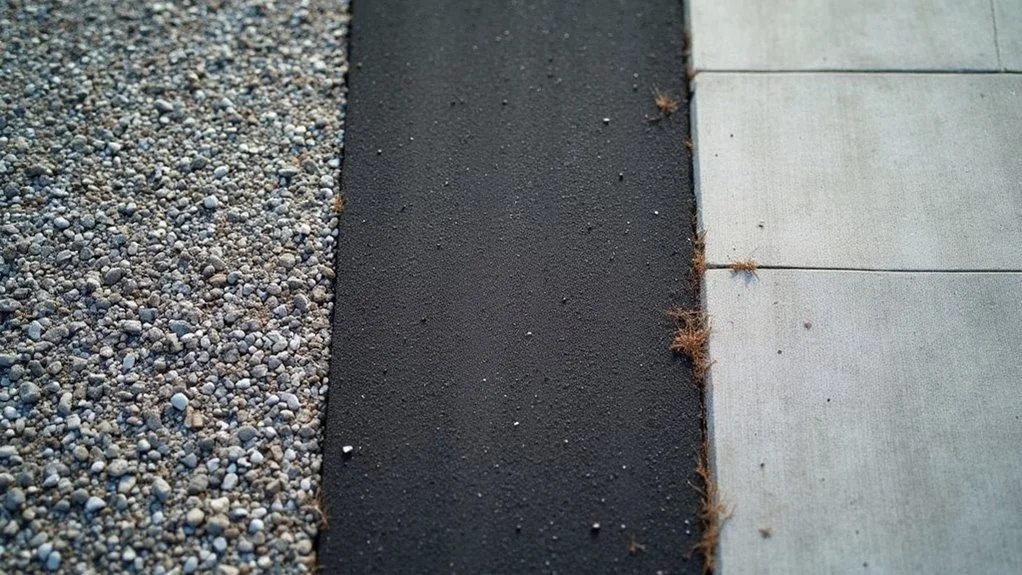
Surface selection is the most consequential early decision in IOS development — and the one most often made on upfront cost alone, without accounting for what Texas weather conditions actually do to a yard.
Why This Decision Matters More Than You Think
Institutional capital is moving into industrial outdoor storage at a pace the market hasn't seen before. Sites are being acquired, improved, and leased up across the Texas Triangle, and the competitive bar for what constitutes a functional, leasable IOS facility is rising. Class A IOS is now defined in part by surface quality — fully paved with proper drainage, not gravel or dirt that creates operational and maintenance headaches.
But not every site justifies full concrete paving on day one. Phased development — start with compacted gravel, upgrade as occupancy stabilizes — has become a mainstream institutional strategy for matching capital deployment to lease-up velocity. The challenge is that "phased" is not the same as "deferred planning." The surface you choose on day one determines your drainage design, your compaction specs, your tenant pool, and your upgrade path. Get it wrong and you're not just maintaining a substandard site — you're rebuilding from scratch.
Texas makes this harder. The heat, the rainfall intensity, the soil conditions, and the load profiles of Texas IOS tenants all create performance demands that a surface spec written for a generic industrial market won't handle.
Gravel: The Right Start, Done Wrong
Gravel is the default entry-level surface for IOS development, and for good reason. It delivers the lowest upfront cost of any stabilized surface, drains reasonably well when properly graded, and can be deployed quickly on sites where entitlement or leasing timelines don't yet justify a full paving investment.
The problem is how most gravel yards are built. Compaction spec and base depth are where gravel installations fail. A yard that gets light compaction and undersized base depth looks fine at delivery and starts deteriorating the moment a loaded 18-wheeler makes its first pass. In Texas clay soils — common across Houston, Dallas, and San Antonio submarkets — poor compaction produces soft spots and rutting that compound with every wet season. Gravel migrates under heavy wheel loads. Ruts develop. Drainage gradients flatten out. The site that was supposed to serve as a cost-efficient starting point becomes a maintenance liability within 18 months.
A properly built gravel yard requires engineered compaction, correct base depth for the expected load class, and a drainage design that accounts for Texas rainfall intensity — not a residential drainage assumption. Done right, it's a legitimate Phase 1 surface that can support a structured upgrade to asphalt without full reconstruction.
Asphalt: The Texas Workhorse With One Weakness
Asphalt is the most common paved surface across Texas IOS sites, and for most applications it's the right call. It handles heavy truck and equipment loads well, can be installed and trafficked within 48 hours, supports stormwater management through engineered slope and drainage design, and runs significantly less than concrete while delivering the paved surface quality institutional tenants increasingly require.
Texas heat is asphalt's ultimate weakness. On a hot Texas afternoon, a dark asphalt surface can reach temperatures that soften the binder layer under sustained point loads — a problem that shows up as rutting under outrigger pads, container stacks, or parked trailer kingpin loads. This is not a reason to avoid asphalt in Texas. It is a reason to specify correctly: base thickness, binder grade, and surface mix spec all need to account for the thermal environment. An asphalt spec written for a Chicago industrial yard will underperform in Houston.
Maintained properly — crack sealing on schedule, surface treatment before the oxidation curve gets ahead of you — a well-built Texas asphalt yard has a long operational life and a straightforward upgrade path if tenant mix or load profiles shift.
Concrete: The Right Answer in Specific Zones
Concrete is not a cost effective whole-site solution for most Texas IOS developments, but it is the right answer in specific areas. Container stacking zones, heavy equipment pads, crane outrigger areas, and primary truck circulation lanes that carry the highest load cycles — these are the locations where concrete's rigidity and load capacity justify the higher per square foot cost premium over asphalt.
Concrete does not rut under sustained point loads the way asphalt can in Texas heat. It handles the weight concentration of stacked containers and static crane pads without the thermal softening risk. It also lasts longer under high-cycle traffic without the regular maintenance cadence that asphalt requires. The trade-off is upfront cost, cure time before the surface can be trafficked, and the fact that concrete repairs are more visible and complex than asphalt patching.
The practical answer for most Texas IOS sites is a hybrid: concrete in the zones that need it, asphalt across the broader yard. Designing that split correctly from the start — rather than adding concrete pads reactively after surface failures — is where good site planning pays off.
Straight Answers
Can I just start with gravel and pave later?
Yes, if it's planned that way from day one. The grading and drainage design for a gravel yard that will eventually be paved is different from a gravel-only installation. If you build your gravel yard without accounting for the future paving spec, the upgrade path gets significantly more expensive.
Does Texas heat really change the asphalt spec?
Yes. Binder grade selection for Texas summer temperatures is not the same as a northern climate spec. A contractor without Texas industrial experience may default to a spec that performs adequately in mild conditions and degrades faster than expected here. Ask specifically how the spec accounts for thermal load.
What do institutional tenants actually require?
Logistics and trucking tenants with modern equipment increasingly require paved, stable surfaces — gravel yards limit your tenant pool and your lease rate ceiling. The Class A IOS benchmark is a fully paved site. If your five-year plan includes institutional-quality leasing, the surface plan needs to reflect that from the start, even if the upgrade is phased.
What are local municipalities and jurisdictions requiring?
Texas state requirements are the floor, not the ceiling. The TCEQ's Multi-Sector General Permit governing industrial stormwater discharges is being renewed with updates taking effect in 2026, meaning IOS owners need to verify their surface and drainage plans meet updated requirements, not just the ones they were originally approved under.
Houston, Dallas, and Austin each layer their own local stormwater rules on top of state requirements, and some municipalities require stormwater permits for sites as small as 0.25 acres depending on location and watershed sensitivity. Gravel surfaces generate more sediment runoff and draw more scrutiny. Paved surfaces drain more predictably and are easier to document for compliance. Early planning is what keeps a surface decision from turning into a permitting problem.
The Surface Decision Is a Capital Decision
Every IOS surface choice is a statement about the site's long-term positioning. Gravel done right is a legitimate Phase 1. Asphalt specified for Texas conditions is the right workhorse surface for most of the yard. Concrete belongs in the high-load zones where it earns its cost premium. The mistake isn't choosing gravel or asphalt — it's choosing without a plan for what comes next, or building to a spec that doesn't account for what Texas will do to it.
S-Bar Construction builds and maintains IOS surfaces across Texas. We spec for the load, the climate, and the upgrade path — not just the day-one budget.
Contact S-Bar Construction to talk through your IOS site surface plan. www.sbarconstruction.com