Water Is the Hidden Constraint Nobody Is Talking to Texas Industrial Owners About
Everyone knows Texas has a grid problem. The water problem is bigger — and it's coming for industrial sites too.
The Constraint Getting Less Attention
While grid capacity has dominated headlines, water is quietly becoming the more consequential long-term constraint for industrial development in Texas.
A report from the Houston Advanced Research Center estimates that Texas data centers are set to use 49 billion gallons of water by the end of 2025 — rising to 399 billion gallons by 2030, potentially accounting for 6.6 percent of Texas's total water usage.
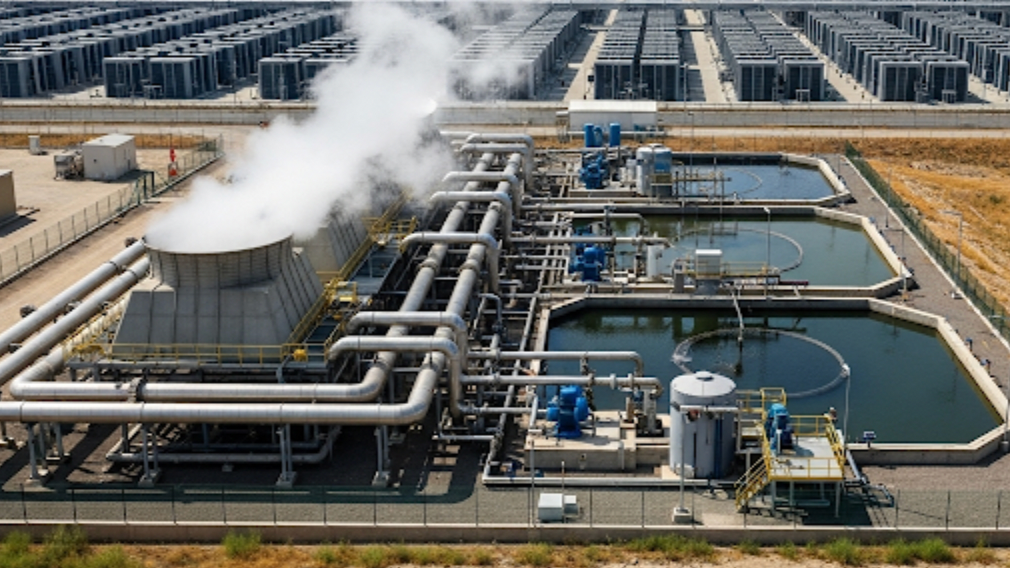
Texas leads the nation in AI computing capacity, and its business-friendly environment is encouraging more data centers to be built. The problem: data centers and their associated powersources consume enormous amounts of water, and most of the state faces drought or near-drought conditions.
For industrial warehouse owners and IOS developers, this isn't just an environmental story. The same municipal water systems serving your facilities are being tapped by data center developments that consume millions of gallons per day — and Texas was already projecting significant water shortages before that demand existed.
What the Numbers Show
According to the TCEQ, there are 64 public water systems currently limiting usage to avoid shortages, with severe drought alerts across Central Texas and the Rio Grande Valley.
The number of data centers identified by the Texas Water Development Board increased from 22 in its 2023 survey to 341 in 2025. Most have not reported their water use as required — meaning the truescale of industrial water demand is almost certainly larger than any official projection captures.
Texas is already projecting significant water shortages as population growth drives up demand while drought, aquifer depletion, and declining reservoir capacity reduce reliable supplies — and many of those projections were developed before the data center boom.
How This Affects Your Industrial or IOS Site
Municipal water system capacity. In fast-growing Texas metros, municipal systems are under pressure from population growth alone. Adding data center demand — largely invisible in current planning projections — compresses available capacity for existing industrial users. In Corpus Christi, officials are projecting a water emergency driven by industrial demand and prolonged drought, with supply projected to fall short within 180 days. The underlying dynamic is playing out at varying degrees across the state.
Groundwater access in unregulated areas. Some groundwater conservation districts have already denied permits or explored moratoriums on high-volume users. The Blanco-Pedernales Groundwater Conservation District passed a resolution in April 2026 calling for legislative action to protect groundwater resources from large-scale industrial development. A site with groundwater access today may face restrictions by the time your facility is operational.
Cooling infrastructure for modern industrial buildings. Climate-controlled logistics facilities and automated warehouses use significantly more water than legacy buildings — for HVAC cooling, fire suppression, and their MEP systems. As water costs rise and municipal systems impose restrictions, buildings not designed with water efficiency in mind will carry the highest operational exposure.
What Smart Owners Are Doing Now
Verify water source and municipal capacity before acquisition — not after. In groundwater-dependent areas, check the relevant conservation district for pending rule changes before committing capital. Early engagement with the district before formal submission can identify project viability issues before they become expensive surprises.
Design MEP and HVAC systems for water efficiency from day one. Closed-loop cooling, low-consumption fixtures, and stormwater reuse reduce both operating costs and exposure to future restrictions. For existing portfolios, aging cooling systems connected to stressed municipal supplies need to be on the capital plan.
S-Bar’s Role
We build and maintain industrial facilities designed for the Texas environment — and in 2026 that environment includes water scarcity as a real operational variable. When we assess a site, water infrastructure goes alongside electrical capacity, drainage compliance, and surface condition. When we spec a renovation or new build, MEP and HVAC systems account for where Texas water availability is heading — not where it was a decade ago.
The owners who face the least disruption are the ones building now with that reality already priced in.
Contact S-Bar Construction to discuss your site improvement program. www.sbarconstruction.com
FAQs
Does my standard industrial warehouse actually face water risk, or is this just a data center issue?
It's both. Data centers are the primary driver of the increased demand — but the municipal systems and aquifers they're drawing from are the same ones your facility depends on for HVAC cooling, fire suppression, and daily operations. In water-stressed areas like Central Texas and the Rio Grande Valley, municipal systems are already imposing usage restrictions. As data center demand grows, those restrictions become more likely in more markets. Any industrial owner whose facility depends on municipal water in a drought-prone Texas market should be treating water availability as a real operational variable — not a background assumption.
How do I check water availability before acquiring a Texas industrial site?
Start with the municipal utility serving the area and ask directly about current system capacity and any existing or anticipated usage restrictions. For sites in groundwater-dependent areas outside municipal service territories, identify the groundwater conservation district with jurisdiction over the parcel and review their current permit rules and any pending rule changes. Several Texas Groundwater Conservation Districts have already implemented or are considering restrictions on high-volume industrial users following the data center boom. Engaging the district before formal submission — rather than after acquisition — is the most cost-effective due diligence step available.
Does building for water efficiency actually cost more upfront?
It depends on the scope, but in most cases the premium is modest relative to the long-term operational savings. Closed-loop HVAC systems have higher upfront equipment costs than open-loop evaporative cooling — but eliminate ongoing water consumption costs and reduce exposure to future usage restrictions. Low-consumption plumbing fixtures add minimal cost at the construction stage. Stormwater reuse systems vary widely in cost depending on site design. The more meaningful answer is that retrofitting water efficiency into a building that wasn't designed for it costs significantly more than building it right the first time — which is why S-Bar recommends spec’ing for water efficiency as a baseline on every new industrial project in Texas, not as an upgrade.